






Most people researching vision correction start with a general search for LASIK, not specific technology names like WaveLight® PLUS or iDesign. Those names show up once you’re already comparing options, and most patients don’t realize going in how different the underlying technology can be. iDesign and WaveLight® PLUS are technologies used to plan and guide a LASIK procedure, each mapping your eye differently before the laser ever touches your cornea. SMILE is a separate procedure entirely; it skips the corneal flap and the excimer laser altogether. Understanding that distinction, plus how each technology maps your eye and what it can treat, matters more than most patients realize.
We treat patients from Colorado Springs, Pueblo, and the surrounding area. This guide breaks down what each technology actually does, what the clinical data shows, and why we made the deliberate choice not to offer SMILE at Skyline LASIK.
Why Vision Correction Technology Matters More Than You Think
Vision correction technology is not interchangeable. Each platform captures different data, maps your eye differently, and delivers a different level of treatment customization. When you choose a practice, you’re also choosing a technology, and that choice affects your visual quality for years, not just on day one.
The most meaningful differences between platforms come down to three things:
- How much of your eye is mapped (cornea only vs. the full optical system)
- What types of imperfections can be corrected (basic refractive errors vs. higher-order aberrations)
- How personalized the treatment plan is (standardized vs. patient-specific down to thousands of individual data points)
Here’s where iDesign, WaveLight® PLUS, and SMILE each stand on those criteria.
The Three Technologies: What They Are and How They Work
WaveLight® PLUS Ray Tracing
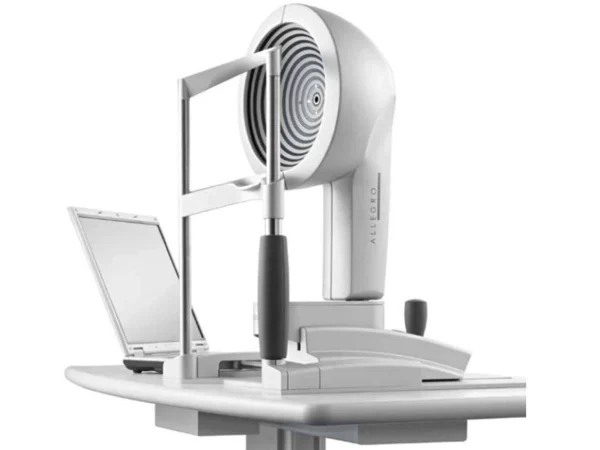
WaveLight® PLUS is the newest generation of the technology we use to plan and guide LASIK. Despite the similar-sounding name, WaveLight® (Alcon’s brand name for this laser platform) isn’t the same thing as wavefront technology, the older measurement method used by iDesign. Where iDesign maps your optical system using wavefront sensing, WaveLight® PLUS goes further, using true 3D ray-tracing to map how light actually travels through your eye.
Ray-tracing doesn’t just measure the shape of your cornea or the wavefront of your eye. It captures thousands of individual light rays as they travel through your cornea, lens, and entire optical system. This identifies subtle distortions that prior technologies either averaged out or missed entirely. The result is a treatment plan built around how your eye actually behaves optically, not a mathematical approximation of it.
WaveLight® PLUS is powered by the Alcon WaveLight® EX500 excimer laser and paired with the Alcon InnovEyes SightMap diagnostic device, which handles the ray-tracing analysis.
Combined, they deliver:
- True 3D optical mapping via thousands of ray-tracing data points
- Treatment of myopia, hyperopia, and astigmatism
- Comprehensive correction of higher-order aberrations
- Sharper contrast and night vision, even in low light
- Precision targeting of complex and irregular astigmatism
- Rapid visual recovery, often within 24 hours
iDesign Wavefront-Guided LASIK
iDesign, developed by Johnson & Johnson Vision, is an advanced wavefront-guided technology used to plan and guide LASIK. Wavefront technology measures how light bends and distorts as it travels through your eye, creating a detailed map of these imperfections before surgery. iDesign takes this further, mapping more than 1,200 data points across your entire optical pathway, not just your cornea. This makes it more comprehensive than earlier wavefront-guided technologies that focused mainly on the corneal surface.
iDesign uses the STAR S4 IR® Excimer Laser System and is FDA-approved to correct nearsightedness (myopia), farsightedness (hyperopia), and astigmatism. It’s also the only system approved for monovision LASIK, a technique some patients over 40 use to reduce their need for reading glasses by correcting one eye for near vision and one for distance.
Key characteristics of iDesign:
- Maps 1,200+ data points across your entire optical system
- Treats myopia, hyperopia, and astigmatism
- Corrects higher-order aberrations — subtle imperfections in how light travels through your eye that can cause glare, halos, or hazy night vision even when your prescription is technically 20/20
- FDA-approved for wavefront-guided LASIK and PRK
- Paired with J&J’s STAR S4 IR excimer laser
iDesign is a meaningful step forward over standard LASIK, and many practices use it as their primary platform. It’s a capable, FDA-approved technology with strong clinical backing.
SMILE (Small Incision Lenticule Extraction)
SMILE skips the corneal flap altogether. A single femtosecond laser cuts a lens-shaped piece of tissue, called a lenticule, into the middle layers of your cornea. Your surgeon extracts it through a small opening at the edge of the cornea, usually 2 to 4 millimeters wide, and the cornea settles into its new shape as it heals. No excimer laser is involved in the correction itself.
The flapless approach appeals to some patients, particularly those with concerns about flap-related risks or who work in occupations with elevated eye trauma risk, such as military personnel or contact sport athletes. Some patients also experience less dry eye in the short term compared to traditional LASIK, though this benefit isn’t universal.
SMILE comes with limitations every patient deserves to understand clearly:
- SMILE treats myopia and astigmatism only. It can’t correct farsightedness (hyperopia).
- Treatment customization is more standardized than WaveLight® PLUS or iDesign.
- If your vision needs fine-tuning later, called an enhancement, SMILE patients often need a separate LASIK or PRK procedure to do it.
- Visual recovery may be more gradual in some patients.
- Long-term outcomes data is more limited than the 20+ year track record of LASIK platforms.
SMILE is a legitimate vision correction procedure. But it’s not the most advanced option, and it’s not the right fit for every patient.
Side-by-Side: How the Technologies Compare
Here’s what these technical differences actually mean for your day-to-day vision.
| iDesign | WaveLight® PLUS | SMILE | |
|---|---|---|---|
| Technology Generation | Advanced wavefront-guided | Newest: 3D ray-tracing | Flapless lenticule extraction |
| Conditions Treated | Myopia, hyperopia, astigmatism | Myopia, hyperopia, astigmatism | Myopia & astigmatism only |
| Data Capture Method | 1,200+ wavefront data points | Thousands of individual ray traces | Standardized lenticule |
| Optical System Coverage | Entire optical system | Entire optical system | Corneal only |
| Night Vision & Glare Quality | Improved | Best available | Standard |
| Corneal Flap | Yes | Yes | No |
| Visual Recovery | 24–48 hours | Often within 24 hours | Days to weeks |
| Enhancement Options | Available | Straightforward | Requires separate procedure |
| Complex Astigmatism | Good | Best available | Limited |
All three procedures use numbing eye drops. Patients typically describe pressure, not pain, and most sit through the actual treatment in under a minute per eye.
What the Clinical Data Shows
Research on outcomes points consistently toward WaveLight® PLUS for the sharpest visual results.
The most direct comparison to date comes from a study presented at the 2025 annual meeting, where the same patients had one eye treated with each procedure. A surgeon at NYU Medical School treated 60 patients with WaveLight® PLUS LASIK in one eye and SMILE Pro in the other, then measured both eyes under the same conditions three months later.
The refractive accuracy gap stood out most: every eye treated with WaveLight® PLUS landed within a quarter-diopter of its target prescription, a level of precision SMILE Pro reached far less consistently. On visual acuity, 98% of WaveLight® PLUS eyes reached 20/12.5 or better, sharper than standard 20/20, compared with 82% of SMILE Pro eyes. That gap matters in daily life: driving at night, reading fine print, and performing in visually demanding situations.
WaveLight® PLUS eyes also showed measurably lower higher-order aberrations and clearer contrast than SMILE Pro, especially in low light. These differences trace back to ray-tracing’s ability to capture and correct subtle aberrations that more standardized approaches can’t address.
What Makes Ray-Tracing Different From Wavefront-Guided LASIK?
Earlier LASIK technologies, including iDesign, use wavefront sensing to measure how light reflects back out of your eye. WaveLight® PLUS goes further by tracing thousands of individual rays of light through your full optical system, capturing how each ray bends and distorts as it passes through your cornea, lens, and the gel-like vitreous inside your eye.
The practical result is a treatment plan that addresses more of what causes soft or hazy vision after LASIK. That includes subtle aberrations affecting contrast, glare, halos, and night vision, imperfections that wavefront mapping alone doesn’t always catch but ray-tracing identifies with precision.
If you’re active in Colorado Springs, whether that means skiing in low light, driving at altitude after sunset, or just wanting sharp vision without a second thought, that difference in optical quality is one you’re likely to notice.
Why Doesn’t Skyline LASIK Offer SMILE?
We’ve chosen not to offer SMILE, and it’s a deliberate clinical decision, not a technology gap.
- Farsightedness is common among the patients we see, and SMILE isn’t approved to correct it.
- WaveLight® PLUS and iDesign each plan treatment around your eye’s specific optical data. SMILE’s process is largely the same from patient to patient.
- In the most direct comparison available, WaveLight® PLUS produced sharper visual outcomes than SMILE Pro.
We invest in technology based on outcomes, not on what’s newest or most marketed. When the evidence points to a better result for our patients, that’s the direction we go.
Who Is a Candidate for WaveLight® PLUS?
Most patients who qualify for standard LASIK are also candidates for WaveLight® PLUS. General requirements include:
- Age 18 or older with a stable prescription for at least one year
- Adequate corneal thickness and healthy corneal anatomy
- Myopia, hyperopia, or astigmatism within treatable ranges
- No active eye disease, significant dry eye, or keratoconus
- Realistic expectations about outcomes
WaveLight® PLUS is particularly well-suited for patients who have:
- Complex or high astigmatism, including irregular astigmatism
- Large pupils (which can reduce the risk of night vision issues common with older technologies)
- Higher-order aberrations affecting visual clarity beyond standard prescription correction
- Demanding visual requirements (pilots, surgeons, athletes, and active outdoor lifestyles)
We determine candidacy for any vision correction procedure through a comprehensive consultation with advanced diagnostic testing. Not every patient is a candidate, and we’ll always recommend the approach that’s genuinely best for your eyes, even if that means PRK or EVO ICL™ instead.
Want a quick read on where you stand? Take our LASIK Candidacy Quiz.
Why Choose Skyline LASIK for Ray-Tracing LASIK?
The platform is only part of the equation. The surgeons behind the technology matter just as much.
At Skyline LASIK, our two board-certified ophthalmologists are fellowship-trained cornea and refractive surgery specialists with more than 50,000 vision correction procedures and 20+ years of experience between them.
We maintain an above 98% patient satisfaction rate, and more than 90% of our patients achieve 20/20 vision or better. These numbers reflect not just technical skill, but a consistent commitment to clinical outcomes over procedure volume.
We were the first practice in Colorado to offer WaveLight® PLUS Ray Tracing. That distinction reflects an ongoing investment in advancing what we can offer patients, not a marketing claim. When technology demonstrates measurably better outcomes, we adopt it.
All vision correction procedures we perform are elective and not covered by medical or vision insurance. If cost is part of your decision, we accept HSA and FSA funds and offer financing options, and we’ll walk through your specific numbers at your consultation.
Ready for Clear Vision?
The first step toward knowing whether WaveLight® PLUS is right for you is a comprehensive consultation at our Colorado Springs practice, serving patients throughout Colorado Springs and Pueblo. Your visit includes advanced diagnostic testing, corneal mapping, and an honest conversation with our surgeons about your candidacy and your goals.
Schedule Your Complimentary Consultation
Frequently Asked Questions
Is One of These Technologies Safer Than the Others?
All three — iDesign, WaveLight® PLUS, and SMILE — are FDA-approved with strong, well-documented safety records. The real differences between them come down to precision, customization, and which conditions they treat, not fundamentally different safety profiles. Your own risk factors, like corneal thickness or dry eye, matter more for your safety than which technology you choose. We’ll walk through your specific risk factors at your consultation.
What Should Farsighted Patients Consider Instead of SMILE?
Farsightedness isn’t correctable with SMILE at any practice, not just at Skyline LASIK, so this isn’t a limitation unique to us. WaveLight® PLUS and iDesign both remain solid options and are worth raising at your consultation.
How Do I Know Which Technology Is Right for Me?
We determine candidacy and technology selection through a comprehensive pre-operative evaluation that includes corneal mapping, optical system analysis, pupil measurement, and a full discussion of your prescription and visual goals. We’ll recommend the approach that offers the best outcome for your eyes. An honest evaluation, not a sales conversation, is the starting point for every recommendation we make.
Sources
American Academy of Ophthalmology. “Latest Evolution of LASIK Technology Shows Superior Results in New Study.” Presented at the AAO Annual Meeting, October 18, 2025. https://www.aao.org/newsroom/news-releases/detail/latest-evolution-of-lasik-technology-shows-results
Johnson & Johnson Vision. “FDA Approves the Next Generation of Customized LASIK Treatment with iDESIGN Refractive Studio.” https://johnsonandjohnson.gcs-web.com/news-releases/news-release-details/fda-approves-next-generation-customized-lasik-treatment-idesign
